Send this resource to your team or professional network.
TB 500 vs Thymosin Beta 4: these peptides are frequently confused, but TB-500 (the synthetic stabilised fraction) and Thymosin Beta-4 (the full native peptide) are structurally distinct compounds. Researchers studying TB 500 vs Thymosin Beta 4 need to understand these differences to interpret experimental results correctly. For primary literature, see Huff et al. Thymosin Beta-4 review (PubMed) and Sun et al. TB-500 tissue repair study (PubMed).
TB 500 vs Thymosin Beta 4: Key Structural and Mechanistic Differences
What is TB-500, and how does it differ from thymosin beta-4?
TB-500 is the acetylated seven-residue thymosin beta-4 fragment described in FDA’s 2026 review; full-length thymosin beta-4 contains 43 residues. Researchers must match a study’s exact material to the supplier identity record because sellers use the TB-500 name inconsistently. A shared name does not establish a shared molecule. Read the FDA identity assessment, pages 7–10.
The US Food and Drug Administration’s briefing document, prepared for the Pharmacy Compounding Advisory Committee meeting of 23 July 2026, defines TB-500 as “a seven amino acid synthetic fragment of thymosin β4 from amino acids 17 to 23”, with the sequence Ac-Leu-Lys-Lys-Thr-Glu-Thr-Gln-OH (LKKTETQ).
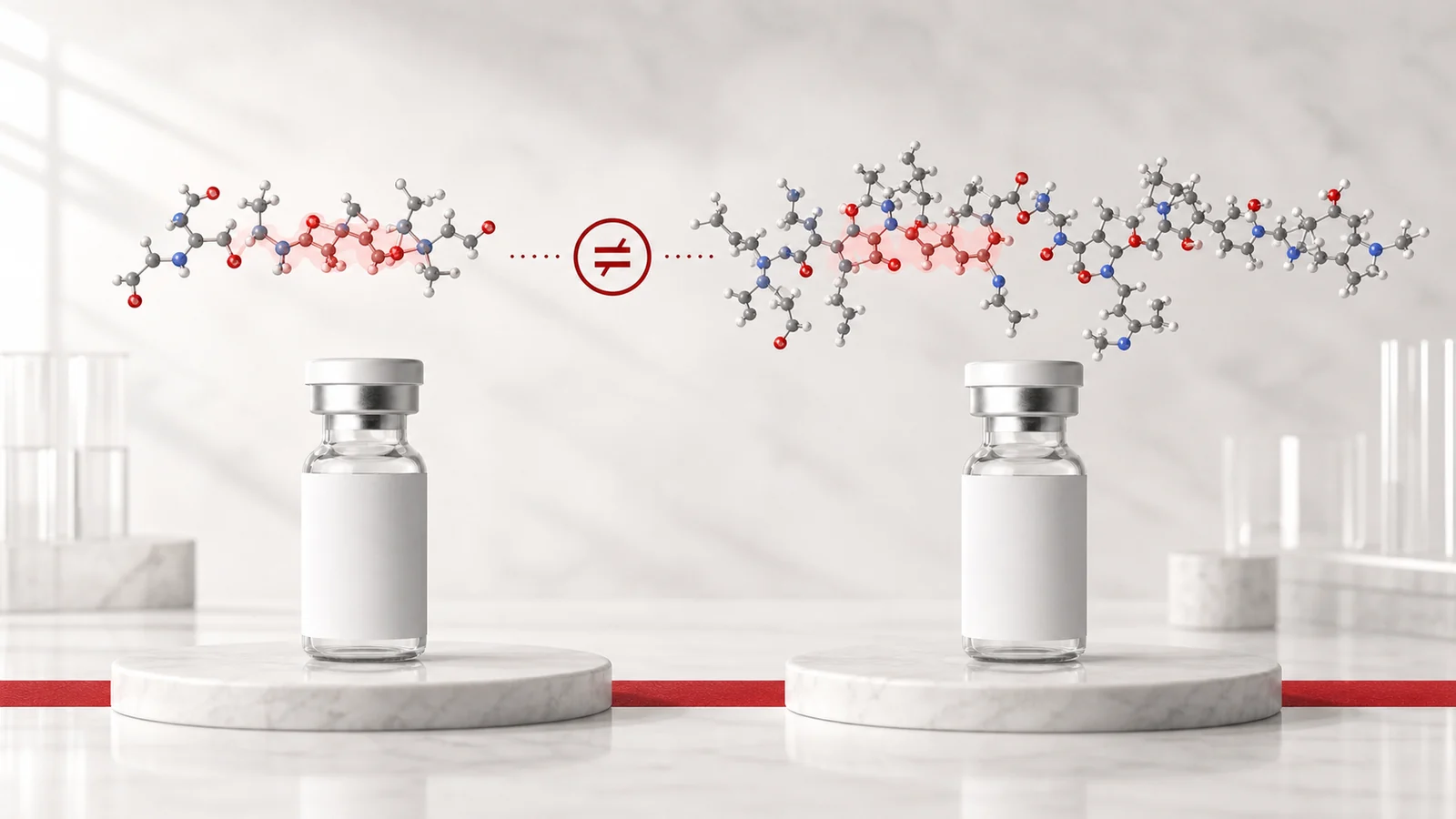
Thymosin beta-4 is a 43-amino-acid protein. TB-500 is a seven-residue fragment of it. Seven residues out of forty-three is not a synonym, and the distinction matters for anyone reading the literature, because the two are not interchangeable in it.
| Comparison | Thymosin beta-4 (Tβ4) | TB-500 as defined in the FDA review |
|---|---|---|
| Length | 43 amino acids | 7 amino acids |
| Sequence | Full native protein | Ac-LKKTETQ-OH (residues 17–23) |
| Human trial evidence | A separate literature for specific thymosin beta-4 formulations | FDA found none |
Why the molecular distinction changes the evidence
Evidence from a trial belongs to the exact material, formulation and application tested. Even where a thymosin beta-4 formulation has been investigated in people, that does not validate the seven-residue TB-500 fragment or a commercial vial sold under the same name.
Check the test material before interpreting a claim about clinical trials. In its July 2026 review, FDA found no clinical studies of TB-500 free base or acetate in humans. The agency also identified a fibroblast wound-model study that did not show the claimed wound-healing effect. These findings concern the defined fragment and the evidence available to that review. FDA evidence review, pages 23–30.
What FDA recommended for the July 2026 meeting
FDA staff recommended against adding TB-500 to the 503A bulk substances list, citing the absence of human data, inadequate physical and chemical characterisation, no submitted Certificate of Analysis, no nonclinical toxicity studies, and immunogenicity concerns for injectable use.
FDA describes advisory committee recommendations as non-binding. A discussion or recommendation about compounding does not itself authorize a drug product, and it does not establish Canadian authorization. The official meeting page explains the committee’s role and links the agency’s materials.
Status in Canada
Health Canada lists TB-500 among examples of unauthorized injectable peptide drugs in its April 9, 2026 advisory. The agency warns that these drugs have not been assessed for safety, efficacy and quality, and that research-use-only labels do not exempt them from regulatory requirements. Consult the current Health Canada advisory and your institution’s requirements when assessing material and intended use.
For tested athletes there is no ambiguity either: the 2026 WADA Prohibited List names it explicitly under S2 growth factors — “Thymosin-ß4 and its derivatives e.g. TB-500” — prohibited at all times, in and out of competition, as a non-Specified Substance.
Why any of this matters when you are buying
Request the supplier identity record and the analytical report for the supplied lot. Compare the named sequence, terminal modifications and reported mass with the material in the paper. HPLC purity alone does not establish identity, vial content, sterility or biological activity.
TB-500 research: which material did the studies test?
Researchers have studied full-length thymosin beta-4, selected fragments and peptides containing its actin-binding region. The distinction matters when reading about cell migration, angiogenesis or tissue repair. Use the following source map to identify what each report can support.
| Source and material | Research model and observation | Limit when interpreting a TB-500 listing |
|---|---|---|
| Malinda et al., 1999 Thymosin beta-4 |
Rat skin-wound research reported greater re-epithelialization, collagen deposition and angiogenesis. | The authors tested thymosin beta-4. This is not a human trial or an identity test of a commercial TB-500 vial. |
| Philp et al., 2003 Thymosin beta-4 and defined peptides |
Endothelial-cell and vessel-sprouting experiments linked angiogenic activity to the seven-residue actin-binding region. | A result for a defined research peptide does not establish that a supplier’s product has the same identity or activity. |
| Bock-Marquette et al., 2004 Thymosin beta-4 |
Cell and mouse cardiac research reported migration and survival findings associated with ILK and Akt signaling. | The study concerns thymosin beta-4 in experimental models, not clinical outcomes from this TB-500 product. |
| FDA review, July 2026 TB-500 free base and acetate |
The agency assessed the defined fragment’s identity and evidence, and found no clinical studies establishing its use in humans. | Full-length thymosin beta-4 studies cannot fill the fragment’s missing human evidence. |
This is a selected source summary, not a systematic review. Read each original report for its methods, limitations and material definition. We checked these sources on September 6, 2026.
TB-500 mechanism of action: what can be inferred?
Actin helps cells maintain shape and move. Research on thymosin beta-4 and defined actin-binding peptides examines these interactions alongside endothelial migration and vessel formation. A proposed mechanism offers a research question; it does not establish the clinical effectiveness of a fragment or a commercial lot. Keep the molecule, model and measured outcome together when recording a finding.
TB-500 human studies and half-life claims
FDA’s review did not identify human pharmacokinetic or pharmacodynamic studies of TB-500 free base or acetate. A specific human half-life or dosing schedule therefore cannot be validated from that review. Half-life also differs from the duration of a biological response or the storage stability of a vial. See the human pharmacokinetic assessment on page 29.
Frequently asked questions
Are TB500, TB-500 and TB 500 the same name?
These are common spellings of the same label. Spelling does not distinguish full-length thymosin beta-4 from a fragment. Check the supplier identity record and the material named in the study.
Do thymosin beta-4 clinical trials prove TB-500 works?
No. Evidence belongs to the material and formulation tested. FDA’s July 2026 review found no human clinical studies of TB-500 free base or acetate. Read the FDA assessment.
What should I check on a TB-500 certificate of analysis?
Match the product, lot identifier, laboratory and test date. Review the methods and results for identity, purity and content separately. A purity percentage does not verify all three or establish sterility.
How does TB-500 differ from BPC-157?
They are different peptide materials with separate research literature. Read the BPC-157 vs TB-500 evidence comparison for the study models and limits of combination claims.
Primary sources
- FDA Pharmacy Compounding Advisory Committee meeting materials, July 23–24, 2026, including the agency briefing document for TB-500-related bulk drug substances.
- Health Canada public advisory RA-81874, April 9, 2026.
- World Anti-Doping Agency 2026 Prohibited List.
Related Anglo Peptides resources
For a separate comparison focused on experimental models, see BPC-157 vs TB-500. Vial information and routes to request current lot documentation appear on the TB-500 research product page.
Research use only. This article is educational and does not provide medical advice. TB-500 products discussed by Anglo Peptides are not intended for human or veterinary consumption.
Related Peptide Research Articles
Related: BPC-157 vs TB-500 Comparison Guide, Ipamorelin Half-Life and Dosing Research, and Peptide Reconstitution Guide.