Send this resource to your team or professional network.
Peptide reconstitution troubleshooting is a common challenge in research laboratories. When a peptide does not dissolve as expected, the issue usually traces back to solvent selection, preparation technique, or storage conditions. See also our acetic acid vs bacteriostatic water guide and bacteriostatic water guide. For published guidance on peptide solubility, review the Thermo Fisher peptide solubility resource.
This peptide reconstitution troubleshooting guide covers the four most common failure modes: cloudiness, foaming, gelling, and failure to dissolve. Each section includes an explanation of the cause and the recommended laboratory response. Researchers may also consult the NIH peptide handling guidelines for additional context.
This comprehensive peptide reconstitution troubleshooting reference is organized to help researchers identify the problem quickly. Whether your peptide reconstitution troubleshooting issue involves cloudiness, foaming, or gelling, the sections above provide the diagnostic steps needed. For related topics in peptide reconstitution troubleshooting, see our full reconstitution guide collection.
Peptide Reconstitution Troubleshooting: What Went Wrong and Whether It Is Recoverable
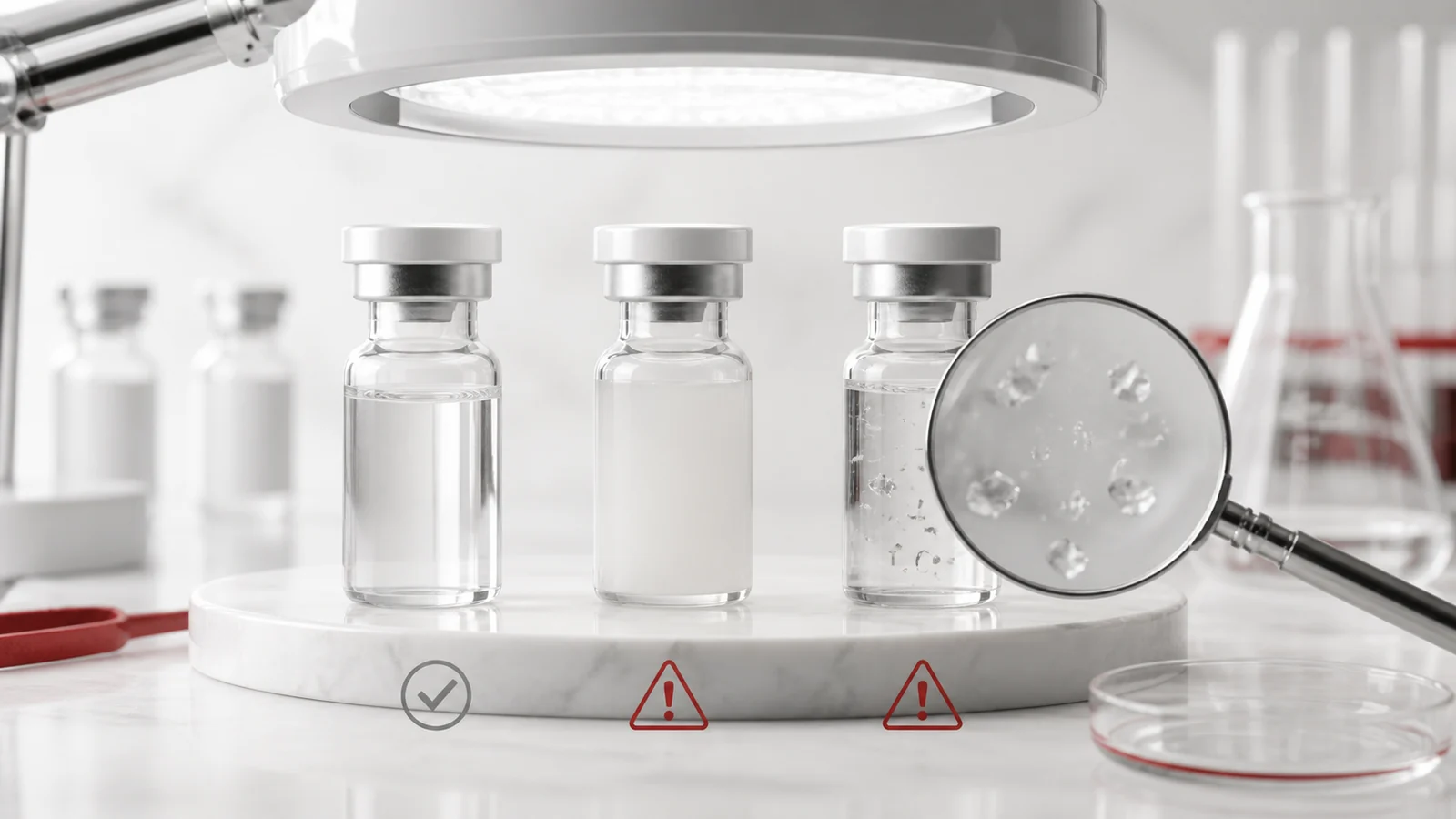
Peptide reconstitution troubleshooting begins with identifying which of four root causes applies: too little diluent, too much agitation, temperature, or a genuine quality issue with the material. This page works through the symptoms in the order people actually encounter them.
| Symptom | Most likely cause | Recoverable? |
|---|---|---|
| Foaming on contact | Diluent added too fast, or shaken | Usually — let it settle |
| Cloudy, clears slowly | Cold solution, or under-diluted | Usually |
| Cloudy, will not clear | Concentration too high, or aggregation | Sometimes |
| Gel-like or viscous | Fibril formation | No |
| Visible particles or strands | Aggregation, or contamination | No — discard |
| Solution turns yellow | Degradation or oxidation | No — discard |
Foaming
Peptides are surface-active, so agitation drives them to the air-water interface where they unfold. That is what the foam is: partially denatured peptide. A little is cosmetic and settles. Vigorous foam from shaking means material has been lost.
Prevention: aim the needle at the glass wall and let the diluent run down it. Never inject directly onto the powder cake, and never shake. Swirl.
Cloudiness
Distinguish two cases. Cloudiness that clears over several minutes with gentle swirling is simply incomplete dissolution — give it time and warmth. Cloudiness that persists is different and means either the concentration exceeds what the peptide will hold in solution, or aggregation has begun.
The fix for the first is patience. The fix for the second is more diluent, if you catch it early.
Gelling
Specific to aggregation-prone peptides, amylin analogues such as cagrilintide most notably. Fibril formation is not reversible — no amount of warming or swirling returns a gelled solution to a usable state.
It simply will not dissolve
Usually a solubility mismatch. Peptides differ in how readily they dissolve in neutral aqueous solution depending on their amino acid composition and isoelectric point. A peptide whose isoelectric point sits near the pH of the solution is at its least soluble. Options are more diluent, more time at room temperature, or a different diluent.
Choosing a diluent
| Diluent | Contains | Use |
|---|---|---|
| Bacteriostatic water | 0.9% benzyl alcohol | Multi-use access; the default |
| Sterile water | Nothing | Single use only, no preservative |
| Dilute acetic acid | Acid, lowers pH | Peptides that resist neutral aqueous solution |
The benzyl alcohol in bacteriostatic water is the reason a vial can be accessed more than once — it inhibits microbial growth. Plain sterile water offers no such protection.
Storage after reconstitution
Refrigerate at 2–8 °C, protect from light, and do not freeze a reconstituted solution. Freeze-thaw cycling is among the most reliable ways to destroy a peptide. Lyophilized powder is a different matter and tolerates freezing well; it is the solution that does not.
A reconstituted vial left at room temperature overnight is a judgement call that depends on the diluent used and how long. Bacteriostatic water buys you margin that sterile water does not.
Research use only. This is a laboratory handling guide for licensed researchers. It is not medical advice, and research peptides are not for human use.
Correctly reconstituting peptides is the single most important step for reproducible research results. This step-by-step guide covers the materials, the method, common mistakes, and storage, so your prepared solutions are consistent every time.
On this page
What You Need
Before starting, assemble: your lyophilised peptide vial, bacteriostatic water (the standard reconstitution solvent), an appropriately sized sterile syringe, and alcohol swabs. Use the peptide calculator to determine your target concentration before you begin.
Step-by-Step Reconstitution
1. Bring to room temperature
Allow the lyophilised vial to reach room temperature to reduce condensation and degradation risk.
2. Calculate your volume
Decide the final concentration and the matching solvent volume using the peptide calculator.
3. Add solvent slowly
Draw the bacteriostatic water and let it run slowly down the inside wall of the vial, never inject it forcefully directly onto the peptide pellet.
4. Do not shake
Swirl gently or let it dissolve on its own. Shaking can shear and denature the peptide. See our solubility guide for difficult-to-dissolve compounds.
5. Inspect
The solution should be clear. Cloudiness or particulates indicate a problem with technique or material.
Common Mistakes to Avoid
The most frequent errors are forceful injection onto the pellet, vigorous shaking, using the wrong solvent, and inaccurate concentration math. Each undermines reproducibility. For background on why technique matters, see understanding peptides.
Storage After Reconstitution
Reconstituted peptides are stored refrigerated and protected from light, and used within the compound’s stable window. Anglo Peptides supplies research peptides and bacteriostatic water with COAs and Canadian shipping.
Frequently Asked Questions: Peptide Reconstitution Troubleshooting
What water is used to reconstitute peptides?
Bacteriostatic water is the standard solvent for research reconstitution because the benzyl alcohol content inhibits microbial growth over multiple uses.
Why should you not shake a reconstituted peptide?
Shaking creates shear forces that can denature or fragment the peptide, reducing reproducibility. Gentle swirling or passive dissolution is preferred.
How do I calculate reconstitution volume?
Use a peptide calculator: enter the peptide mass and your target concentration to get the exact solvent volume to add.
How long does a reconstituted peptide last?
It depends on the compound, but reconstituted peptides are generally refrigerated, protected from light, and used within their documented stable window.
References
This guide reflects standard laboratory peptide-handling practice. For compound-specific stability data, consult the certificate of analysis and the PubMed-indexed literature for each peptide. Research use only.