Send this resource to your team or professional network.
The short answer: Use bacteriostatic water (BAC water) when reconstituting a peptide you plan to use over multiple doses. Use sterile water for injection only if you are using an entire vial in one session. For most people working with research peptides in Canada, bacteriostatic water is the right call.
What is bacteriostatic water?
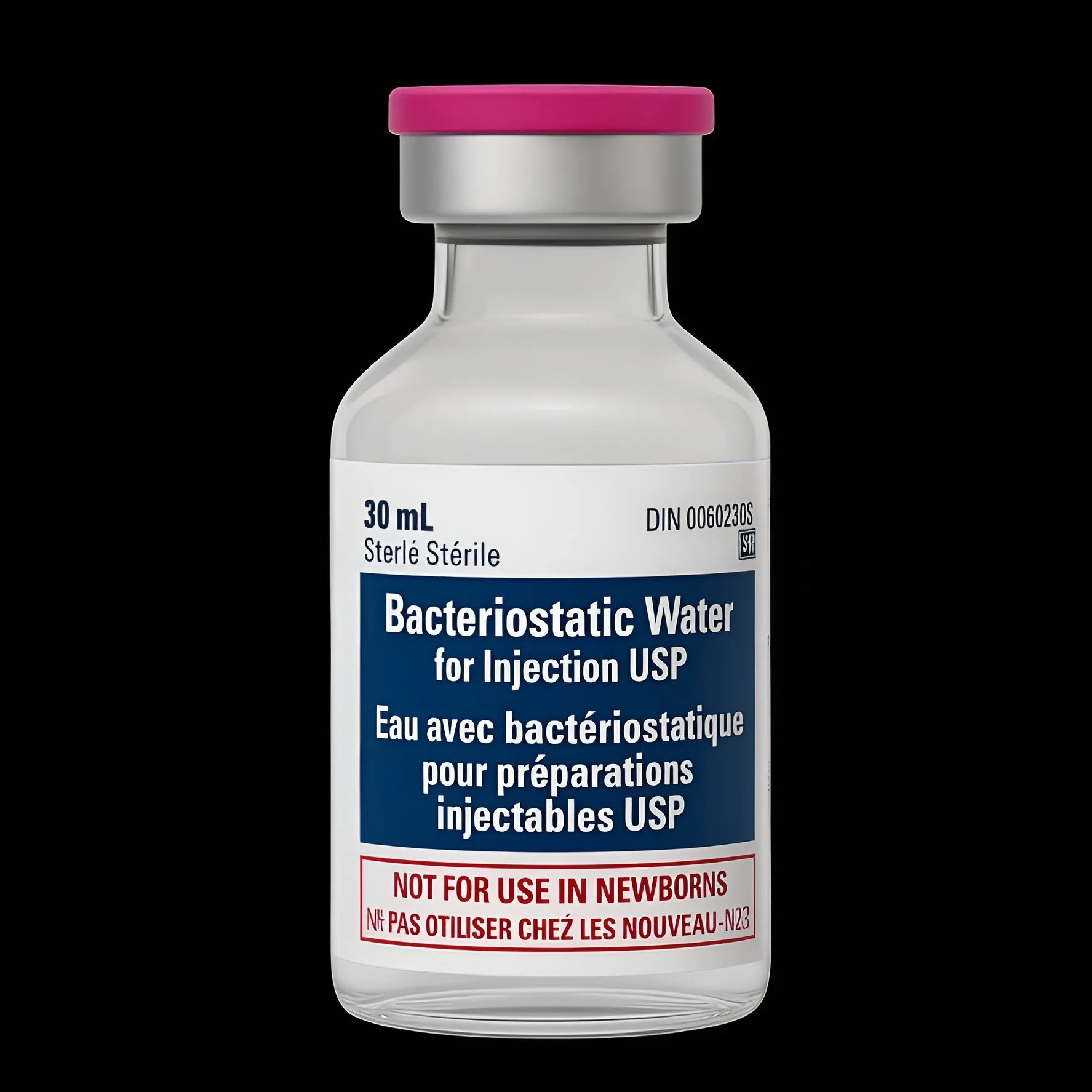
Bacteriostatic water is sterile water for injection with one addition: 0.9% benzyl alcohol. That preservative is what separates it from regular sterile water.
Benzyl alcohol does not interact with the peptide or change how it works. Its job is to stop bacteria from growing inside the vial after you puncture the rubber stopper with a needle. Without it, every time you draw a dose you create a path for contamination. With it, the vial stays safe to use for up to 28 days after first opening.
The 0.9% figure describes the concentration of benzyl alcohol in the water, not some purity rating. People sometimes confuse this with saline, which is 0.9% sodium chloride. They are entirely different products. BAC water contains no salt.
What is sterile water for injection?
Sterile water for injection is purified water with no additives at all. No benzyl alcohol, no sodium chloride, nothing. It comes in single-dose vials because once you open it, there is nothing stopping bacterial growth if you go back to the vial a second time.
If you open a vial of sterile water, draw your full dose, and toss the rest, that is fine. If you open it and plan to come back next week to draw another dose, you are introducing contamination risk every time you re-enter the vial.
Which one do you use for peptides?
For any peptide you will use across more than one injection session, BAC water is what you need. That covers most peptide protocols: semaglutide, tirzepatide, BPC-157, TB-500, retatrutide, and others. A typical 5mg or 10mg vial reconstituted with 1 to 2mL of BAC water will last you multiple weeks of doses. The benzyl alcohol keeps the reconstituted solution protected across those uses.
Sterile water works only when you are using a full vial in a single session, or when a specific protocol requires preservative-free water for a particular reason. For research peptide use in Canada, BAC water is the standard.
How to reconstitute peptides with BAC water
You need the peptide vial, a BAC water vial, two alcohol swabs, and insulin syringes.
Wipe the rubber tops of both vials with an alcohol swab. Draw the desired volume of bacteriostatic water into your syringe. For a 5mg peptide vial, 1mL to 2mL of BAC water is typical depending on your preferred concentration and dose size. Inject the BAC water slowly into the peptide vial by angling the syringe so the liquid runs down the inside wall of the glass rather than directly onto the powder. Hitting the powder at pressure can degrade it.
Gently swirl the vial, do not shake it. The powder should dissolve within 30 to 60 seconds and the solution should come out clear. Once the peptide is fully dissolved in the bacteriostatic water, store the vial in the fridge immediately at 2 to 8 degrees Celsius.
Bacteriostatic water reconstitution ratios
| Peptide vial size | Bacteriostatic water added | Dose per 0.1mL drawn |
|---|---|---|
| 2mg | 1mL | 0.2mg |
| 5mg | 1mL | 0.5mg |
| 5mg | 2mL | 0.25mg |
| 10mg | 2mL | 0.5mg |
| 10mg | 4mL | 0.25mg |
These are starting points. Adjust based on your exact dose and how you want to measure it. A 1mL insulin syringe reads in 0.01mL increments, so smaller volumes per dose can be easier to draw accurately at higher concentrations.
Does BAC water need to be refrigerated?
The unopened vial does not. The Pfizer label specifies storage at 20 to 25 degrees Celsius, which is room temperature. Keep it away from direct sunlight and away from freezing.
Once you use BAC water to reconstitute a peptide, the resulting solution goes in the fridge. The benzyl alcohol protects against bacteria, but the peptide itself is more sensitive to temperature than the water is. Refrigeration slows peptide degradation and extends how long the reconstituted solution stays potent.
How long does a vial last after opening?
An opened BAC water vial stays usable for 28 days as long as you use proper sterile technique each time you draw from it. After 28 days, discard and open a new one.
Most reconstituted peptide solutions in the fridge follow the same 28-day window, though this varies by compound. BPC-157, TB-500, semaglutide, and tirzepatide are all generally stable for 28 days when stored cold. The stability clock starts when you add the BAC water to the peptide vial, not when you first opened the original lyophilized powder.
Buying bacteriostatic water in Canada
BAC water is not a controlled substance, but pharmacies do not typically stock the injectable grade that peptide users need. Most Canadians working with research peptides order it online.
Anglo Peptides carries pharmaceutical-grade bacteriostatic water with domestic shipping across Canada. Orders typically arrive within 2 to 5 business days depending on your province. We stock the 30mL Pfizer format, which covers multiple reconstitutions and keeps your per-vial cost down.
Frequently Asked Questions
What is the difference between bacteriostatic water and sterile water for injection?
Bacteriostatic water contains 0.9% benzyl alcohol as a preservative. Sterile water for injection contains nothing but purified water. The preservative is what makes BAC water safe to use across multiple doses from the same vial. Sterile water for injection is single-dose only and should be discarded after one use.
Can I use sterile water instead of BAC water for peptides?
Only if you plan to use the entire reconstituted vial in one session. If your protocol involves drawing from the same vial across multiple days or weeks, sterile water is not suitable because re-entering the vial with a needle introduces contamination risk each time. BAC water is the standard for multi-dose peptide protocols.
What does the benzyl alcohol in BAC water actually do?
It stops bacteria from surviving inside the vial after you puncture the rubber stopper. Every time you insert a needle to draw a dose, you create a potential entry point for airborne microbes. The benzyl alcohol prevents those microbes from growing in the solution. It does not interact with the peptide or affect how the compound works in any way.
Can I shake the vial when mixing my peptide?
Do not shake it. Shaking can break the peptide chains through mechanical stress. Swirl the vial gently in a circular motion until the powder fully dissolves. If particles are still visible after a minute, let the vial sit in the fridge for 30 minutes and try swirling again. Never rush it with shaking.
Does BAC water need to go in the fridge?
The unopened vial is stored at room temperature, 20 to 25 degrees Celsius. Once you use it to reconstitute a peptide, the reconstituted solution goes in the fridge. The remaining bacteriostatic water in the vial can stay at room temperature until you need it for another reconstitution.
How long does BAC water last once I open it?
Your bacteriostatic water vial lasts 28 days from the first needle puncture, provided you use clean technique each time. After 28 days, discard the vial regardless of how much is left. The same 28-day window applies to most reconstituted peptide solutions stored in the refrigerator.
What size syringe do I use?
Use an insulin syringe, typically 29 to 31 gauge with a 0.5mL or 1mL capacity. The thin gauge keeps the hole through the rubber stopper small, which helps maintain the seal across multiple uses. A 1mL syringe is most practical for drawing 1 to 2mL of BAC water during reconstitution.
Is BAC water the same as saline?
No. Saline is 0.9% sodium chloride in sterile water. BAC water is 0.9% benzyl alcohol in sterile water. The 0.9% refers to a completely different ingredient in each product. Do not substitute one for the other. Saline is not appropriate for reconstituting research peptides.
What if I added too much BAC water when reconstituting?
Adding extra bacteriostatic water does not degrade the peptide, but your dosing math changes. If a 5mg vial was meant to be reconstituted in 1mL but you added 2mL, each 0.1mL you draw now contains 0.25mg instead of 0.5mg. Recalculate your draw volume based on how much BAC water you actually used. Write the reconstitution ratio on the vial so your doses stay consistent throughout the protocol.
Where do I buy bacteriostatic water in Canada?
Anglo Peptides ships BAC water domestically across all provinces. Local pharmacies rarely carry the injectable grade, and ordering internationally means customs delays and uncertainty around cold-chain handling. Domestic sourcing from within Canada gives you faster delivery and consistent supply.
Can I buy bacteriostatic water at Shoppers Drug Mart?
Shoppers Drug Mart and other Canadian pharmacy chains do not stock injectable-grade bacteriostatic water. Pharmacies carry medications for dispensing by prescription, and bacteriostatic water for injection is not a standard retail item at the counter. Your best option in Canada is ordering from a domestic online supplier. Anglo Peptides ships bacteriostatic water across all provinces, typically arriving in 2 to 5 business days.
How much bacteriostatic water do I add to a peptide vial?
That depends on your vial size and your preferred dose concentration. For a 5mg peptide vial, adding 1mL of bacteriostatic water gives you 0.5mg per 0.1mL drawn. Adding 2mL instead gives you 0.25mg per 0.1mL, which makes it easier to measure smaller doses precisely. For a 10mg vial, 2mL gives you 0.5mg per 0.1mL. A quick rule: write your reconstitution ratio directly on the vial cap before refrigerating it. See the dosing table above for common vial sizes.
What is the best bacteriostatic water for peptides in Canada?
The Pfizer 30mL bacteriostatic water vial is the standard most Canadian peptide researchers use. Pfizer manufactures it under pharmaceutical-grade quality controls, and the 30mL size covers multiple reconstitutions without constant reordering. Avoid single-use sterile water vials for any multi-dose protocol — without benzyl alcohol, re-entering the vial introduces contamination risk. Anglo Peptides carries the Pfizer 30mL format with domestic shipping across Canada.