Send this resource to your team or professional network.
Understanding acetic acid vs bacteriostatic water is essential for researchers working with research peptides. This guide covers the key differences between acetic acid vs bacteriostatic water, and when each diluent is appropriate for laboratory reconstitution. See also our bacteriostatic water guide and reconstitution troubleshooting guide.
The choice between acetic acid vs bacteriostatic water depends on the peptide’s molecular charge, isoelectric point, and the requirements of your analytical protocol. Most peptides reconstitute successfully in bacteriostatic water; a smaller subset require dilute acetic acid (0.1% v/v) to achieve proper solubilization.
When choosing acetic acid vs bacteriostatic water for peptide reconstitution, the compound’s isoelectric point and solubility profile determine the right diluent. Acetic acid and bacteriostatic water serve different purposes. An acidic solvent changes the chemical environment; BAC Water contains a preservative. Choose a diluent using the compound’s documentation and the requirements of the intended assay. A solvent that dissolves a sample may still interfere with the experiment.
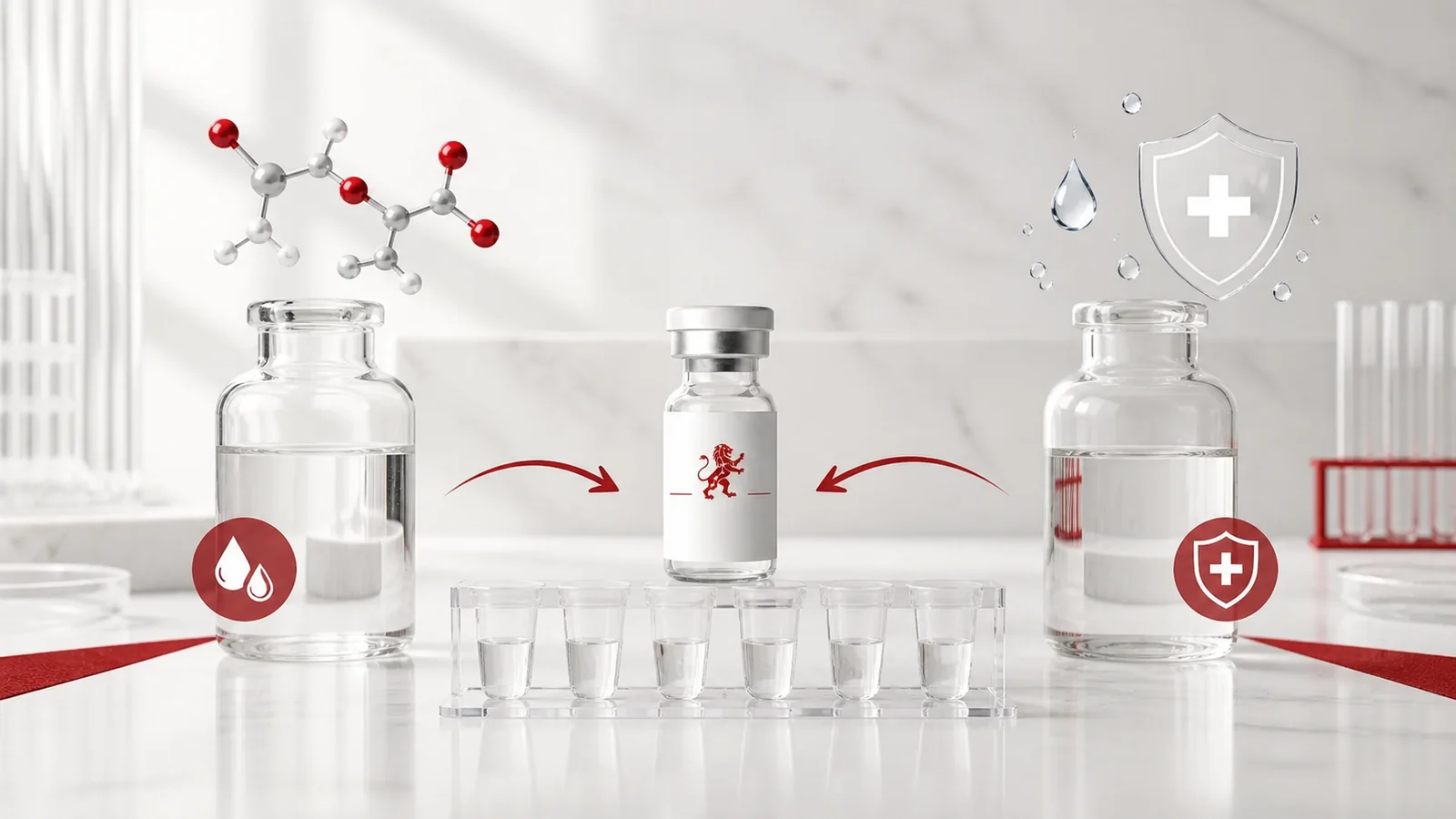
Acetic Acid vs Bacteriostatic Water: Compare the Formulation Before Choosing a Diluent
| Question | Bacteriostatic water | Acetic acid solution |
|---|---|---|
| What is being compared? | The Pfizer/Hospira 30 mL formulation contains 0.9% benzyl alcohol. | A solvent whose concentration, grade and specification must be identified. |
| What about pH? | The linked Hospira label specifies pH 5.7, with a range of 4.5–7.0. It is not a pH 7 buffer. | Acidic; the actual pH depends on the formulation and sample. |
| Does it establish compatibility? | No. The preservative does not establish compatibility with every peptide. | No. Acidity alone does not establish compatibility, sterility or stability. |
Check the Pfizer/Hospira manufacturer label for the BAC Water formulation. The table does not describe every product sold under either solvent name.
Charge, hydrophobicity and assay compatibility
Thermo Fisher’s custom-peptide guidance identifies charge, hydrophobicity, downstream compatibility and stability as factors in solvent selection. Its recommendations differ by peptide composition. This supports a compound-specific review; it does not support using BAC Water first for every peptide or adding acid whenever a solution remains cloudy.
The isoelectric point helps explain charge behaviour, but it is only one part of that review. Record the exact material, formulation and analytical evidence. A purity report alone does not supply a validated solvent system or shelf life.
For the broader decision process, read the peptide solubility guide. For the distinction between preserved and unpreserved water, use bacteriostatic water vs sterile water.
Common Questions: Acetic Acid vs Bacteriostatic Water
Is BAC Water the best solvent for every research peptide?
No. Confirm suitability against the material’s documentation and the laboratory’s approved protocol before selecting a solvent.
Does acetic acid replace BAC Water whenever a sample does not dissolve?
No. An unresolved appearance needs a documented assessment. Adding another solvent changes the formulation and may affect later measurements.
Does benzyl alcohol guarantee four weeks of peptide stability?
No. The opened-container guidance for a preserved water bottle does not validate the chemical stability of another substance mixed with it. The storage and label guide explains the distinction.
BAC Water product and planning tools
View the Pfizer/Hospira 30 mL BAC Water product for current stock, packaging and price. Use the BAC Water calculator to total a volume already specified by your protocol. It does not choose a solvent or validate a procedure.
Source review: September 7, 2026. Educational laboratory context only; this comparison does not provide an injection, dosing or reconstitution protocol.