Send this resource to your team or professional network.
Why GHK Cu stings is one of the most frequently asked questions in copper peptide research. GHK Cu (glycyl-L-histidyl-L-lysine copper) causes localised injection site reactions due to its copper chelation activity and pH characteristics. Understanding why GHK Cu stings helps researchers optimise protocols and minimise discomfort. For copper peptide chemistry background, see Pickart et al. (PubMed): GHK-Cu mechanisms and Lipner et al. wound healing copper review (PubMed).
Why GHK-Cu Stings: The Chemistry of Injection Site Reactions
Why GHK-Cu stings more than other peptides
Of all the compounds handled in this space, GHK-Cu produces the most complaints about injection-site pain — burning, welts, lumps and lingering red marks. It is the most-searched question about the peptide in Canada and almost nobody answers it properly.
There are four contributing factors, and they are worth separating because two are within your control and two are not.
1. Concentration and dilution volume — controllable
GHK-Cu is commonly supplied in 50 mg vials, far larger than the 5–10 mg typical of other peptides. Reconstituting 50 mg into 2 mL produces a dramatically more concentrated solution than reconstituting the same vial into 5 mL. Concentration is the single largest driver of local irritation, and it is entirely a function of how much diluent is used.
2. pH — controllable
Copper-peptide solutions sit away from physiological pH, and the further from roughly 7.4 a solution sits, the more it stings. Diluent choice matters here: bacteriostatic water and acetic-acid-containing solutions do not behave the same way.
3. The copper complex itself — not controllable
GHK-Cu is a copper-binding tripeptide. The copper ion is the point of the molecule, and it is inherently more irritating to tissue than a plain amino-acid chain. This is why GHK-Cu stings and, say, ipamorelin does not. No handling technique removes this entirely.
4. Purity and endotoxin — not controllable, and the one worth caring about
This is the factor most vendors will not discuss. Peptide-related impurities and bacterial endotoxin both provoke local inflammatory reactions, and both are invisible on a standard HPLC purity certificate.
A 2026 preprint analysed 6,441 grey-market peptide samples across 14 compounds, GHK-Cu among them, and found that between 41.6% and 71.1% failed basic quality criteria depending on the framework applied, with 15% showing measurable endotoxin contamination. That study is a preprint and has not completed peer review, so treat the exact figures with appropriate caution — but the direction is unambiguous, and it is the strongest available argument for insisting on per-batch third-party testing.
The honest version: if a vial stings far more than the same compound from another source at the same concentration and pH, purity is the most likely explanation. That is not a comfortable thing for a supplier to write, but it is what the evidence says.
What actually reduces the sting
- Use more diluent. The most effective single change. Reconstituting into a larger volume lowers concentration proportionally.
- Let it reach room temperature. Cold solution from the fridge stings noticeably more.
- Rotate sites. Repeated administration into the same tissue compounds local irritation.
- Check the COA is for your lot. A certificate from a different batch tells you nothing about the vial in your hand.
Copper toxicity — the question nobody addresses
Because GHK-Cu delivers copper, cumulative copper load is a legitimate pharmacological question, and it is one that ranking Canadian pages simply omit. Copper and zinc compete for absorption and transport, so sustained copper exposure has implications beyond the copper itself. There is no established safe cumulative exposure for injected GHK-Cu in humans, because — see below — there are no human injectable trials at all.
What the human evidence actually is
Thinner than any vendor page suggests. A search of the published literature returns one randomised controlled trial of GHK-Cu in humans: a small study of a topical copper tripeptide complex on CO2 laser-resurfaced skin (Archives of Facial Plastic Surgery, 2006).
There are no randomised controlled trials of injected or systemic GHK-Cu in humans. None. The widely cited Pickart papers are narrative reviews of mechanism, largely authored by the same researcher, built on in vitro and gene-expression work. They are legitimate as mechanism papers and are routinely misrepresented as clinical efficacy evidence.
Regulatory status in Canada
GHK-Cu has no DIN and no Health Canada authorisation. It is named in Health Canada advisory RA-81874 of 9 April 2026, and was among the products seized from a Canadian vendor in August 2025.
One genuine and verifiable distinction: GHK-Cu is not named on the 2026 WADA Prohibited List — unlike TB-500, ipamorelin, CJC-1295, sermorelin and tesamorelin, which all are. That is a statement about the List, not a statement that it is permitted; WADA’s S0 category covers substances with no regulatory approval, and an unapproved injectable could reasonably be argued into it.
Worth knowing too: topical copper peptides are sold legally in Canada as cosmetics — The Ordinary and NIOD both retail them. Same molecule, entirely different regulatory treatment, because route of administration and product claims are what determine classification.
Research use only. The information below summarises peer-reviewed literature on GHK-Cu for licensed laboratory and academic research. It is not medical or cosmetic advice, and research-grade GHK-Cu is not for human use.
GHK-Cu (copper tripeptide-1) is a naturally occurring copper-binding peptide with an extensive research literature in skin, wound-healing and tissue-remodelling models. This guide explains the copper-peptide mechanism, its main research areas, and how to source high-purity material in Canada.
On this page
What Is GHK-Cu?
GHK-Cu is a complex of the tripeptide glycyl-L-histidyl-L-lysine with a copper(II) ion. The peptide occurs naturally in human plasma and declines with age, which is part of why it is studied in regeneration and skin-remodelling research. For background on peptide structure and study methods, see our understanding peptides guide.
How Does GHK-Cu Work?
Much of GHK-Cu’s activity is attributed to its role as a copper carrier and signalling molecule.
Copper delivery
The peptide delivers copper to cells, a cofactor for enzymes involved in collagen and elastin synthesis.
Gene expression and remodelling
Studies report broad effects on genes involved in tissue remodelling, antioxidant defence and wound repair.
What Is GHK-Cu Being Researched For?
Research concentrates on dermal models (collagen synthesis, skin remodelling, wound repair), antioxidant activity, and tissue regeneration. It is sometimes studied alongside repair peptides such as BPC-157.
Handling, Reconstitution & Purity
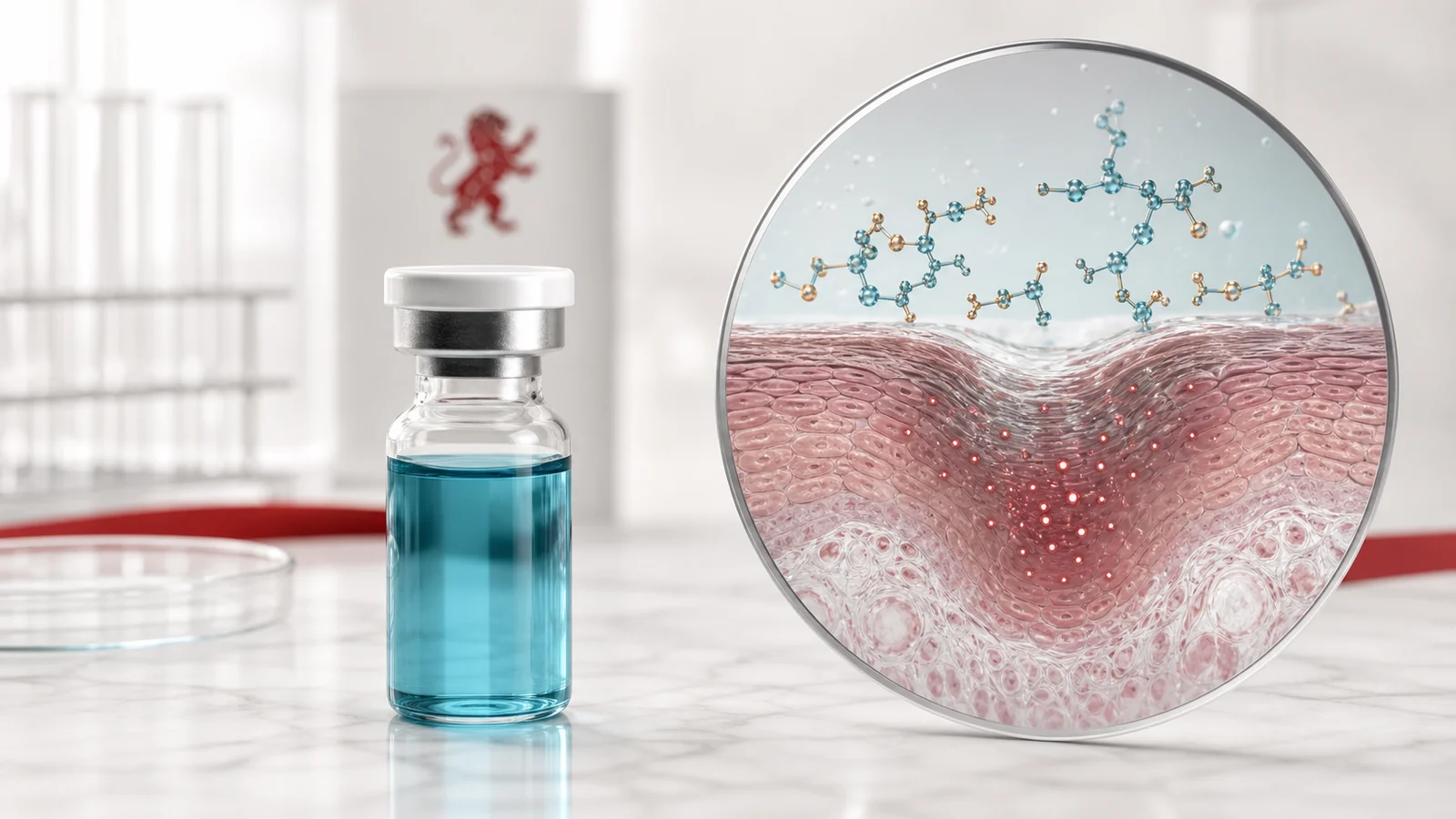
Research-grade GHK-Cu is supplied lyophilised (characteristically blue from the copper complex) and reconstituted with bacteriostatic water. Follow our reconstitution guide and use the peptide calculator; require at least 98% HPLC purity with a certificate of analysis.
Buy GHK-Cu in Canada, Research Grade, COA-Tested
Anglo Peptides supplies third-party-tested GHK-Cu (at least 99% purity) with a certificate of analysis and domestic Canadian shipping.
Frequently Asked Questions
What is GHK-Cu used for in research?
It is studied in skin-remodelling, collagen-synthesis, wound-healing, antioxidant and tissue-regeneration models as a copper-delivery signalling peptide. All use is laboratory-based.
Why is GHK-Cu blue?
The characteristic blue colour comes from the bound copper(II) ion in the tripeptide-copper complex.
What purity should research GHK-Cu be?
At least 98% by HPLC with a batch certificate of analysis. Anglo Peptides material is tested to 99% or higher.
Is research-grade GHK-Cu a cosmetic or medicine?
No. It is a research peptide for laboratory use only and is not for human or cosmetic use.
References
This summary draws on the PubMed-indexed literature on GHK and copper-peptide biology. Review current studies via a PubMed search. Cited effects derive from published research and do not constitute medical advice.
Related Peptide Research Articles
Related: GHK-Cu Peptide: Copper Tripeptide Research and Mechanisms, BPC-157 vs TB-500 Comparison, and Peptide Reconstitution Guide.