


Longevity peptides in Canada include research compounds linked to telomerase, mitochondrial signalling, NAD+ metabolism and tissue remodelling. Researchers also search for anti-aging research peptides when comparing Epitalon, MOTS-C, Thymalin and GHK-Cu, though each compound has a different mechanism and evidence limit.
This guide compares five compounds often grouped under the search term peptides for longevity. Anglo Peptides Canada supplies research material for laboratory and in-vitro work. The products support research questions and are not for human or veterinary use.
Epitalon Research Peptide Canada: Definition and Research Overview
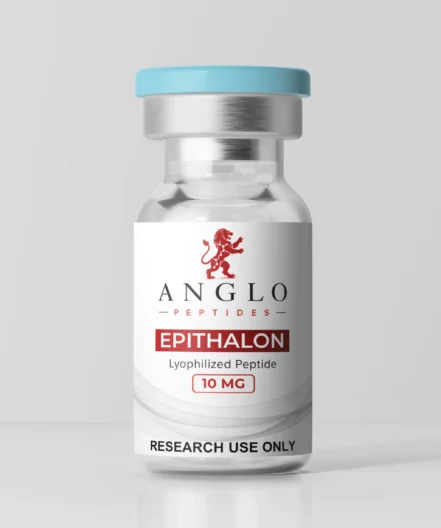
Epitalon, also written Epithalon, is a synthetic tetrapeptide associated with research by Vladimir Khavinson and colleagues. A 2003 cell-culture paper reported telomerase activity and telomere elongation in telomerase-negative human fetal fibroblasts after exposure to the peptide. That experiment supports a defined cellular research question. It does not show that the peptide extends human lifespan or provides an anti-aging treatment.
Laboratories evaluating an Epitalon research peptide Canada source may examine telomerase expression, telomere measurements, cell-cycle markers or circadian endpoints. Study design should identify the cell line, passage number, exposure conditions, controls and assay method. Researchers should separate findings in cultured cells from outcomes in animals or humans.
Primary research: Khavinson, Bondarev and Butyugov, 2003.
Researchers can review the Epithalon research peptide Canada product page for the current vial format and product documentation.
What Current Studies Say About Longevity Peptides
Longevity research spans cell culture, animal models, observational human studies and small clinical trials. The compounds on this page sit at different points on that evidence ladder. No single study supports a general claim that a peptide slows human aging.
MOTS-C is a mitochondrial-derived peptide. A 2021 study reported that exercise increased endogenous MOTS-C expression in human muscle and circulation, while mouse experiments examined physical capacity and age-related decline. Those findings support metabolic and exercise-response research. They do not establish the effects of administering a commercial MOTS-C research vial to people.
NAD+ is a coenzyme rather than a peptide. Human trials often test NAD+ precursors such as nicotinamide riboside or nicotinamide mononucleotide, and those formulations differ from direct NAD+ research material. Some trials report increased NAD-related metabolites, while other studies find no improvement in selected mitochondrial or muscle outcomes. Researchers should avoid treating a biomarker change as proof of longer lifespan.
Thymalin and related thymic preparations appear in older immune-aging literature, but product nomenclature, composition and study quality vary. GHK-Cu research covers copper binding, extracellular matrix signalling and tissue models. That work addresses a different question from lifespan extension.
Selected research: MOTS-C and age-related physical decline · Nicotinamide riboside and NAD metabolism · NAD-precursor trial with neutral muscle outcomes.
Anti-Aging Research Peptides in Canada: Comparison Table
Searches for the best peptides for longevity often group compounds from different research categories. Researchers should compare them by mechanism and evidence level, not as treatments or products for human use.
| Research compound | Main research context | Evidence caution |
|---|---|---|
| Epitalon / Epithalon | Telomerase, telomere and circadian models | Small and early evidence base; cell findings do not prove lifespan extension |
| NAD+ | Redox, sirtuin and metabolic assays | A coenzyme, not a peptide; direct NAD+ differs from tested precursors |
| MOTS-C | Mitochondrial stress and exercise-response models | Animal and endogenous-human findings dominate |
| Thymalin | Thymic and immune-aging research | Composition and nomenclature require verification |
| GHK-Cu | Copper binding and extracellular matrix models | Tissue-repair endpoints do not establish longer lifespan |
Related catalogue pages cover NAD+ research material, MOTS-C research peptide and Thymalin research peptide. Thymalfasin and Thymalin are different compounds, so researchers should verify the product name and molecular identity before comparing studies or ordering materials.
Shop longevity and anti-aging research products


Laboratories ordering several longevity research compounds should define a separate research question, concentration plan, controls and analytical record for each molecule. Combining compounds can make attribution harder and may introduce interactions that the available literature has not tested.
Evidence Quality, Limitations and Safety Context
Evidence quality depends on study design, sample size, model and replication. A cell-culture result can identify a mechanism. An animal experiment can test whole-organism physiology. A controlled human trial can examine defined outcomes in a selected population. Researchers should not convert one evidence tier into a claim about another.
Longevity claims require long follow-up and clinically meaningful outcomes. Telomerase activity, NAD metabolites, gene expression and exercise capacity serve as research endpoints, but none alone proves slower aging or longer human lifespan. Small studies and surrogate markers also create a higher risk of false-positive or overstated conclusions.
A product-page purity claim does not establish sterility, endotoxin status, fill quantity, stability or biological activity. Research results from a regulated or characterized formulation do not transfer to another vial without identity, quality and equivalence work.
Research-use notice: The products and information on this page support laboratory and in-vitro research only. They are not for human consumption, diagnosis, treatment, self-experimentation or veterinary use. Nothing on this page provides medical advice.
Canadian Research, Sourcing, COA and Storage Considerations
Canadian laboratories should match each received vial with its analytical report. Review the compound name, batch identifier, test date, chromatogram and reported mass. Use the Certificate of Analysis page to find available records, and request the current batch report when the lot does not match.
HPLC can report chromatographic purity under the test method. Mass spectrometry can support molecular-mass or identity review. Fill quantity, sterility, endotoxin status and biological activity require separate validated methods. Keep the report with the receiving record and study documentation.
Store each unopened lyophilized product at the temperature listed on its product and batch documentation, protected from light and moisture. Reconstituted stability depends on solvent, concentration, container, temperature and handling time. Use a study-specific SOP and limit repeat freeze-thaw cycles. A universal post-reconstitution timeline cannot cover every compound on this page.
Browse the full Buy Peptides Canada catalogue and use the peptide calculator for concentration planning under the laboratory’s approved procedure.
Frequently asked questions
What does the current evidence say about Longevity Peptides?
The evidence ranges from cell-culture and animal studies to small human trials. Epitalon research includes a cell-culture telomerase study. MOTS-C research includes animal work and measurements of endogenous MOTS-C in people. NAD research often tests precursors rather than direct NAD+. These findings support research questions but do not prove lifespan extension in humans.
How is Longevity Peptides evaluated or used in laboratory research?
Researchers select assays based on the compound and target. Examples include telomerase and telomere measurements for Epitalon, metabolic-stress assays for MOTS-C, redox measurements for NAD+, and immune markers for thymic preparations. Each protocol should define controls, identity checks and acceptance criteria.
What purity, storage and safety limitations should researchers consider?
Review the batch-specific COA and do not treat an HPLC percentage as proof of sterility, endotoxin status, vial quantity or biological activity. Follow the batch-listed storage conditions, protect dry material from light and moisture, and validate reconstituted stability for the protocol. The products are for laboratory research only.
