Send this resource to your team or professional network.
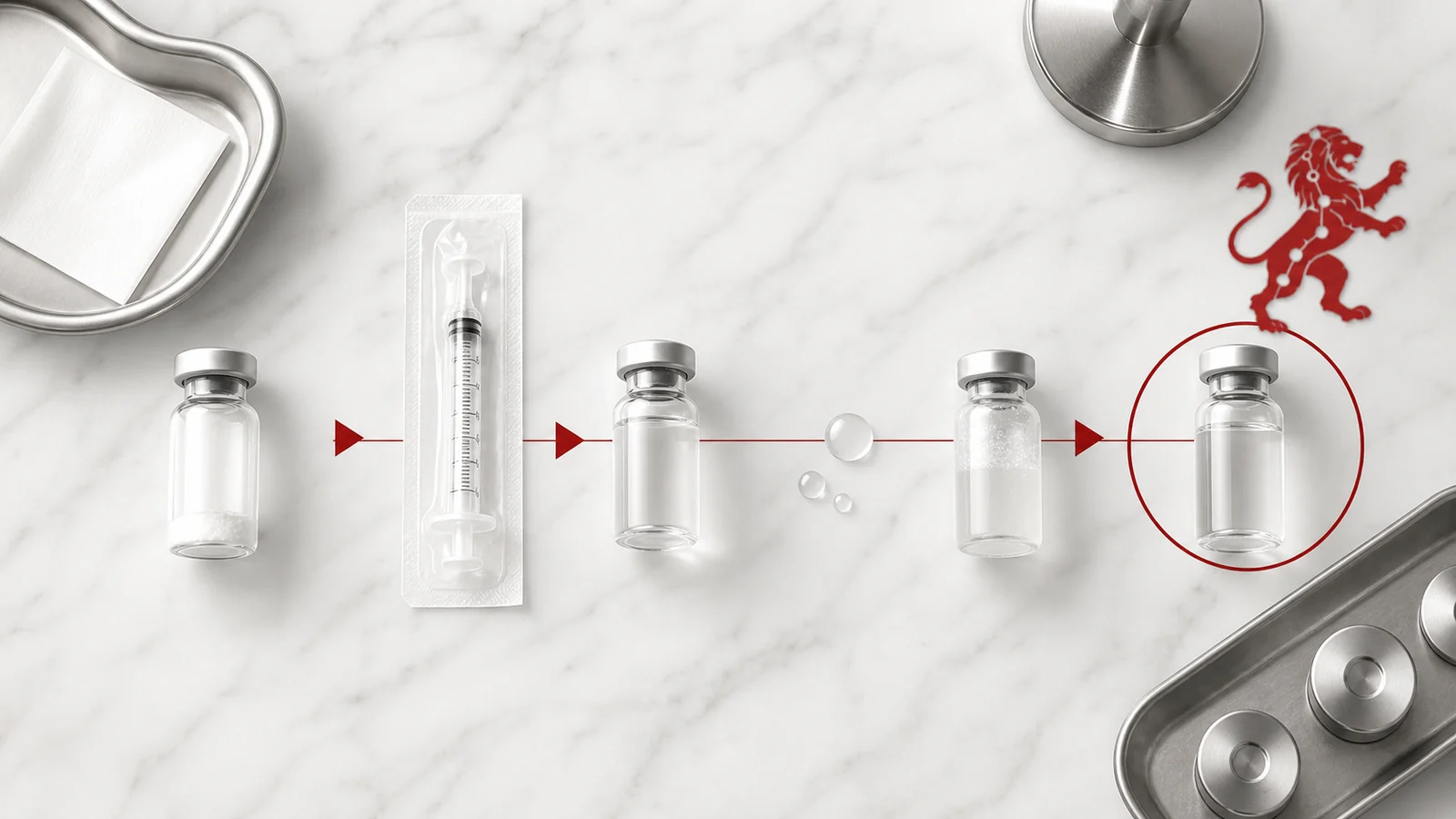
Peptide reconstitution is the process of dissolving a lyophilized (freeze-dried) peptide in an appropriate diluent — typically bacteriostatic water or dilute acetic acid — to create a stable injectable solution for research use. For foundational context, see Manning et al. on peptide formulation stability (PubMed) and USP guidelines on sterile compounding.
Peptide Reconstitution: Step-by-Step Laboratory Protocol
Written course: evidence and planning
These modules explain the decisions to document before reconstitution. Follow the approved procedure for the exact compound and experiment. This course provides no human or veterinary dosing or injection instructions.
Module 1: Peptide fundamentals
Reconstitution means dissolving a dry material in a specified solvent. Researchers need documentation for the material and the intended experiment before choosing that solvent.
Record the product identity, batch and available analytical evidence. Appearance alone cannot confirm purity, sterility or chemical stability.
Module 2: Diluent and equipment review
Review the required solvent, measuring equipment and handling controls in the laboratory protocol. A shopping checklist does not establish compatibility.
The 30 mL Pfizer/Hospira product contains 0.9% benzyl alcohol. Compare its manufacturer information with the requirements of the experiment.
Module 3: Review the procedure
Confirm the solvent specification, permitted concentration, handling conditions and acceptance criteria before work begins. Document any mismatch for review.
Do not treat cloudiness as a reason to improvise with more solvent, heat or acid. Follow the laboratory process for assessing a sample that falls outside its specification.
Module 4: Concentration and volume
Mass concentration is the documented mass divided by the final solution volume. Keep the units consistent and distinguish solvent added from final volume.
Use the BAC Water calculator to total planned diluent volume. Its bottle estimate is an inventory calculation; Anglo permits one bottle per order.
Module 5: Storage and expiry
The manufacturer label specifies 20–25°C storage for this BAC Water product. Check the label and expiry on the bottle supplied.
CDC healthcare guidance generally uses 28 days after first puncture for multidose vials unless the manufacturer specifies otherwise. This is not a universal peptide-stability result.
Use compound-specific evidence for a prepared solution. Read the BAC Water storage and label comparison for source scope.
Module 6: Documentation and limits
Record identity, batch, formulation, dates and storage conditions required by the laboratory procedure. Keep the source of each limit with the record.
This course covers evidence review and basic concepts. It does not establish a universal mixing method, clinical use or qualification to perform laboratory work.
Knowledge check
What establishes a suitable laboratory procedure?
Use evidence for the material and application.
Does a preservative establish compatibility with every peptide?
Preservative content and compound compatibility are separate questions.
An unexpected appearance should trigger…
Appearance is an observation to assess, not a universal troubleshooting instruction.
What can a volume calculator establish?
Calculators cannot validate the assumptions supplied to them.
Does the 28-day multidose-vial rule prove a mixed peptide remains stable?
Container-use guidance does not establish another compound’s chemical stability.
Which statement is supported?
Document the evidence and the applicable procedure.
Related product and guides
Check the Pfizer/Hospira BAC Water product, compare acetic acid and bacteriostatic water, or return to the research centre.
For the composition-dependent nature of solvent selection, see Thermo Fisher custom-peptide guidance. Product and healthcare source links above explain their own scope; they do not validate every material in the catalogue.
BAC-related accuracy review: September 7, 2026. The interactive questions and written version use the same storage and compatibility distinctions.
Peptide Reconstitution: Diluent Selection Guide
Correct diluent selection is the most critical step in peptide reconstitution. Most water-soluble peptides dissolve readily in bacteriostatic water (water for injection preserved with 0.9% benzyl alcohol). Peptides with a high proportion of hydrophobic residues may require initial dissolution in a small volume of dilute acetic acid (0.1–1%) before dilution with bacteriostatic water. The peptide reconstitution protocol should always match the solubility profile documented in the Certificate of Analysis.
Peptide Reconstitution: Concentration Calculations
Research-grade peptide reconstitution typically targets concentrations of 1–2 mg/mL. For a 5 mg vial targeting 1 mg/mL: add 5 mL of diluent. For 2 mg/mL: add 2.5 mL. Never shake vigorously — gentle swirling or rotation preserves peptide integrity. All peptide reconstitution calculations should be recorded in lab notebooks for reproducibility.
Storage After Peptide Reconstitution
After peptide reconstitution is complete, store the vial at 2–8°C for short-term use (up to 4 weeks for most peptides) or at −20°C for longer storage. Avoid repeated freeze-thaw cycles. Reconstituted solutions should be inspected visually for particulates or cloudiness before each use — any change in appearance indicates degradation and peptide reconstitution should be repeated with a fresh vial.
Related Peptide Research Articles
Continue learning: Retatrutide Reconstitution Guide, Cagrilintide Reconstitution Guide, How to Store Peptides.