Send this resource to your team or professional network.
Understanding ipamorelin half-life requires reviewing its pharmacokinetics — the foundational ipamorelin GH selectivity study (Eur J Endocrinol 1998) and ipamorelin half-life and onset pharmacokinetics data establish the 2-hour half-life and lack of cortisol/ACTH elevation that distinguish ipamorelin from other GHRPs.
Ipamorelin Half-Life: 2-Hour Window and Pulsatile GH Release
Ipamorelin is a selective growth hormone secretagogue with a plasma half-life of approximately 2 hours and an onset of GH response within 15–30 minutes of subcutaneous injection. This page covers those pharmacokinetic figures, the human and animal study evidence behind them, and how ipamorelin’s profile compares to other GHRPs when combined with CJC-1295.
Ipamorelin Half-Life: What the Evidence Shows
Ipamorelin’s plasma half-life in humans has not been formally published in the peer-reviewed literature as of 2026. The pharmacokinetic characterization was conducted internally by the original developer (Novo Nordisk) during the drug’s development as a clinical candidate (NN703) and was not published in full.
Available data from Raun et al. (1998), the primary characterization paper, characterized ipamorelin’s GH-stimulating activity in rats, pigs, and dogs rather than full human pharmacokinetics. The GH response in pigs following intravenous ipamorelin was rapid and short-lived — consistent with a short plasma half-life estimated at 1–2 hours from the GH curve profiles. The subcutaneous half-life is typically longer than the IV half-life due to slower absorption from the injection site.[1]
The commonly cited figure of approximately 2 hours for ipamorelin’s half-life is extrapolated from the GH response duration data and the animal pharmacokinetic profiles, not from a direct human pharmacokinetic study with blood sampling at multiple time points. This should be understood as an approximation consistent with the compound’s short peptide structure and the observed GH response duration, not as a formally established human PK parameter.
Onset and Peak GH Response
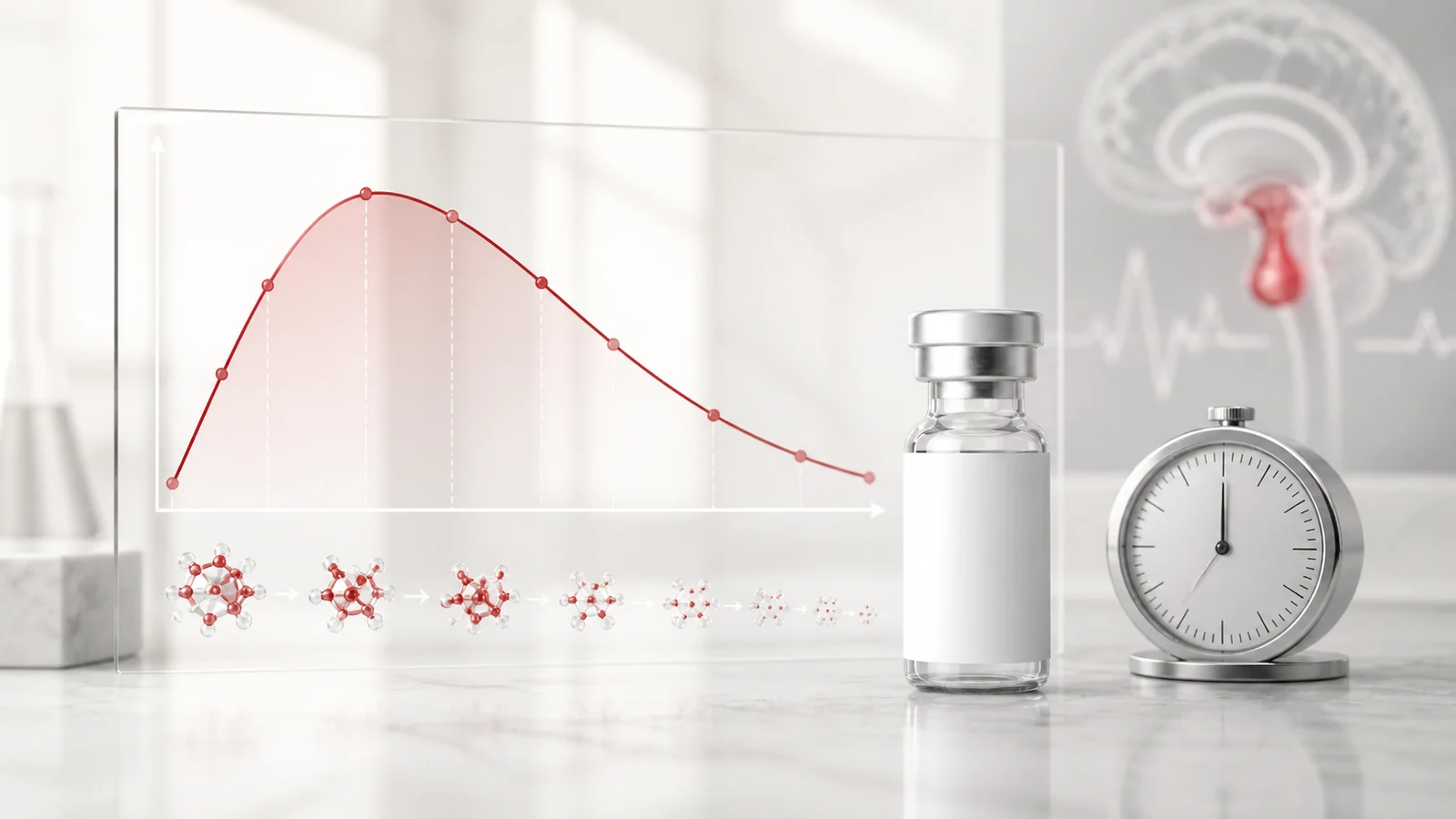
GH response following ipamorelin injection peaks rapidly. In the Raun 1998 pig study, peak serum GH occurred at approximately 15–30 minutes post-injection and returned to baseline within 3 hours. The GH pulse produced was characterized as a single, clean peak — in contrast to GHRP-6 and GHRP-2, which produce a more prolonged and sometimes double-peaked response.
The onset and peak profile is consistent with ipamorelin’s mechanism: activation of GHS-R1a (ghrelin receptor) in the pituitary triggers a rapid, pulse-like GH release that mirrors the physiological GH secretory pattern. The pulse nature is important — it avoids the continuous, non-pulsatile GH elevation associated with synthetic GH administration that may have different downstream effects on GH receptor sensitivity.
Why Ipamorelin Is Preferred: Cortisol and Prolactin
The defining characteristic of ipamorelin vs other GHRPs is its selectivity. At doses that produce maximal GH release, ipamorelin does not significantly raise cortisol or prolactin — the two most important off-target effects of GHRP-6 and GHRP-2.
| Compound | GH Stimulation | Cortisol Increase | Prolactin Increase | ACTH Increase |
|---|---|---|---|---|
| Ipamorelin (at effective GH dose) | Strong | Minimal | Minimal | Minimal |
| GHRP-6 | Strong | Moderate-significant | Moderate | Moderate |
| GHRP-2 | Very strong | Significant | Significant | Significant |
| Hexarelin | Very strong | Significant | Significant | Significant |
The selectivity data comes from the Raun 1998 paper, which compared ipamorelin to GHRP-6 and growth hormone releasing peptide-1 at equimolar doses in pigs and rats. At equivalent GH-stimulating doses, ipamorelin did not elevate plasma ACTH or cortisol in either species, while GHRP-6 produced significant increases in both.[1]
This selectivity profile makes ipamorelin the preferred GHRP in research protocols where minimizing hypothalamic-pituitary-adrenal (HPA) axis stimulation is a priority — particularly when the GH-releasing effect is the target rather than a secondary endocrine effect.
Ipamorelin + CJC-1295: The Standard Research Combination
Ipamorelin is almost universally used in combination with CJC-1295 (modified GRF 1-29 or CJC-1295 with DAC) in growth hormone research protocols. The rationale is mechanistic synergy:
- CJC-1295 acts at the GHRH receptor on pituitary somatotrophs, increasing the amplitude of each GH pulse — more GH per secretory event.
- Ipamorelin acts at GHS-R1a (ghrelin receptor), increasing GH pulse frequency and reducing somatostatin tone — more frequent secretory events and less inhibition between them.
This dual-pathway stimulation produces a synergistic GH increase that is substantially greater than either compound alone, as demonstrated for the GHRH + GHRP class by Khorram et al. (1997) in healthy elderly adults.[2]
For the specific CJC-1295 no-DAC + ipamorelin combination, timing is important: both should be injected at the same time because both have short active windows. The combined pulse produces a larger, cleaner GH peak than either alone. Common research timing: pre-training (30–60 min before exercise, as exercise itself is a natural GH stimulus) and before sleep (GH secretion is highest during slow-wave sleep).
Ipamorelin With CJC-1295 DAC vs No DAC
The choice of CJC-1295 form affects how ipamorelin should be timed:
- With CJC-1295 no DAC (Mod GRF 1-29): Both have similar short active windows. Co-inject once or twice daily. The combined pulse is acute and defined — mimics the physiological pulsatile pattern more closely.
- With CJC-1295 DAC (weekly injection): CJC-1295 DAC maintains a sustained GHRH agonist background over 7 days. Ipamorelin can be injected separately (once or twice daily) to add acute GH pulse stimulation on top of the sustained GHRH tone. Some protocols use CJC-1295 DAC alone without ipamorelin to avoid the complexity of daily injections; the trade-off is the loss of the acute pulse component.
Ipamorelin Structure and Development History
Ipamorelin (Aib-His-D-2-Nal-D-Phe-Lys-NH2) is a 28-amino-acid pentapeptide GHS developed by Novo Nordisk in the late 1990s. It was designed as an improvement on GHRP-6 and hexarelin by retaining GH-stimulating potency while eliminating the cortisol and prolactin side effects. The clinical candidate code was NN703; development was discontinued before Phase III, but the compound remains one of the most widely used research GHRPs due to its clean selectivity profile.
Frequently Asked Questions
What is the half-life of ipamorelin?
Ipamorelin has an estimated plasma half-life of approximately 2 hours, based on animal pharmacokinetic data and GH response curve profiles from the original characterization studies. A formal human pharmacokinetic study with published data is not available in the peer-reviewed literature as of 2026. The GH response peaks within 15–30 minutes of subcutaneous injection and returns to baseline within 3 hours.
How long does ipamorelin take to work?
GH response begins within 15–30 minutes of subcutaneous injection and peaks at approximately 30–60 minutes. The onset time reflects the absorption rate from the subcutaneous injection site and the downstream signal transduction cascade at the GHS-R1a receptor. Combining with CJC-1295 does not significantly delay the onset but increases the amplitude of the GH response.
What is the best ipamorelin dosage?
No approved clinical dosage exists. Research protocols commonly use 100–300 µg per injection, with most protocols using 100–200 µg combined with CJC-1295. The dose-response for ipamorelin’s GH effect plateaus at relatively modest doses (the Raun 1998 pig data suggests maximal GH release is achieved at doses well below the saturation level in most research protocols).
Is ipamorelin safe?
Ipamorelin’s tolerability in preclinical studies was favourable compared to other GHRPs, specifically in not raising cortisol or prolactin at GH-stimulating doses. No formal Phase II or III clinical trial safety data is available. As a research peptide, it is not approved for human use, and its long-term safety profile in humans has not been established in controlled trials.
References
- Raun K, et al. Ipamorelin, the first selective growth hormone secretagogue. Eur J Endocrinol. 1998;139(5):552–561. PMID 9849467
- Khorram O, et al. Activation of the hypothalamic-pituitary-adrenal axis with aging. J Clin Endocrinol Metab. 1997;82(10):3279–3285. PMID 9250450 [GHRH + GHRP synergy in elderly]
Related Research Articles
View Ipamorelin 5mg CJC-1295 + Ipamorelin blend
Explore GHRP and GHRH research: CJC-1295 DAC vs No DAC Guide, Tesamorelin Canada Guide, and GLP-1 Receptor Agonist Guide.