Send this resource to your team or professional network.
The pharmacokinetics of CJC-1295 DAC versus the no-DAC formulation determine dosing frequency — see the foundational CJC-1295 DAC clinical pharmacology study (JCEM 2006) for the half-life data driving this comparison.
CJC-1295 DAC: Mechanism of Extended Half-Life
CJC-1295 is a synthetic analogue of growth hormone releasing hormone (GHRH) that comes in two distinct forms — with and without a Drug Affinity Complex (DAC) modification. The two forms have different pharmacokinetics, different injection frequencies, and different GH secretion profiles. This page explains the structural difference, what the clinical evidence shows, and why CJC-1295 is almost always combined with ipamorelin in research protocols.
What Is CJC-1295?
CJC-1295 is a 30-amino-acid synthetic peptide based on GHRH(1-29), the first 29 amino acids of endogenous growth hormone releasing hormone (native GHRH has 44 amino acids). The modifications from the native sequence include substitutions at positions 2, 8, 15, and 27 to resist enzymatic cleavage by DPP-4 and dipeptidyl aminopeptidase — the enzymes that rapidly degrade native GHRH in plasma.
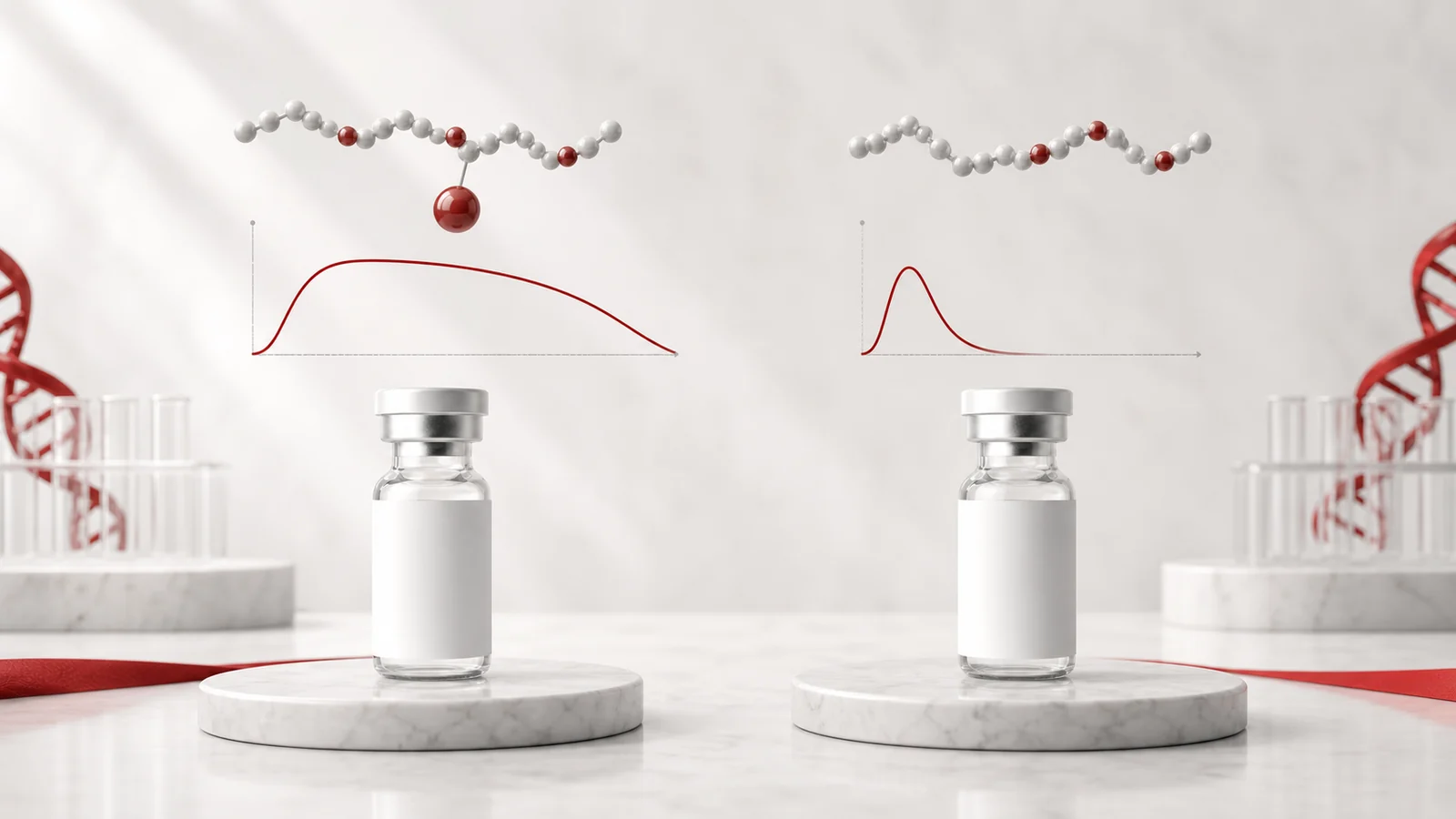
Native GHRH has a plasma half-life of roughly 7 minutes. Standard CJC-1295 (no DAC) extends this to approximately 30 minutes through the amino acid substitutions alone. CJC-1295 with DAC extends it to 6–8 days through an additional albumin-binding modification.
CJC-1295 with DAC vs Without DAC: The Core Difference
The Drug Affinity Complex (DAC) is a maleimidopropionic acid group attached to the lysine at position 27 of the CJC-1295 peptide chain. Once injected, this reactive group covalently bonds to cysteine-34 on circulating serum albumin — the most abundant plasma protein. Because albumin has a half-life of approximately 19 days, anything covalently bound to it inherits dramatically extended plasma residence time.
| Feature | CJC-1295 No DAC (Mod GRF 1-29) | CJC-1295 with DAC |
|---|---|---|
| Also called | Modified GRF 1-29, Mod GRF(1-29) | CJC-1295 DAC |
| Plasma half-life | ~30 minutes | ~6–8 days |
| GH secretion pattern | Pulsatile — sharp peak then return to baseline | Sustained “GH bleed” over 7+ days |
| Typical injection frequency | 3–5× daily (before meals and sleep) | Once weekly or twice weekly |
| IGF-1 effect | Moderate, requires frequent dosing for sustained rise | Sustained 1.5–3× IGF-1 elevation over 7 days |
| Mimics physiology | Closer to natural pulsatile GH secretion | Supraphysiological sustained exposure |
The clinical evidence for CJC-1295 with DAC comes primarily from a Phase I/II human trial (Teichman et al., 2006, N=65 healthy adults, single-dose design). Subjects received subcutaneous injections of CJC-1295 (30 to 180 µg/kg). Results: 2–10 fold mean increases in GH AUC, 1.5–3 fold increases in serum IGF-1, with IGF-1 elevation sustained for 6+ days after a single dose. No serious adverse events were reported at the doses tested.[1]
No published clinical trial data for CJC-1295 without DAC (Mod GRF 1-29) as a standalone compound exists in the peer-reviewed literature as of 2026. The no-DAC form is widely used in research settings based on its pharmacokinetic properties relative to the native sequence, not on independent clinical trial evidence.
CJC-1295 and Ipamorelin: Why They Are Combined
Ipamorelin is a selective growth hormone secretagogue (GHS) — a 28-amino-acid pentapeptide that activates the ghrelin receptor (GHS-R1a) to stimulate GH release. It is structurally unrelated to CJC-1295; they work through entirely different mechanisms.
The rationale for combining them is based on synergy: GHRH agonists (like CJC-1295) and GHRP/GHS agonists (like ipamorelin) act at different points in the GH secretion pathway and produce additive-to-synergistic GH release when given together:
- GHRH (CJC-1295): Increases the amplitude of each GH pulse by stimulating somatotroph cells in the pituitary to release more GH per pulse.
- GHRP/GHS (Ipamorelin): Increases GH pulse frequency, partly by suppressing somatostatin (the GH-inhibiting hormone) and partly through direct GHS-R1a stimulation.
A landmark study by Khorram et al. (1997) in healthy elderly adults showed that combined GHRH + GHRP-2 administration produced a synergistic increase in GH that was significantly greater than either peptide alone (N=13).[2] This synergy is the mechanistic basis for the CJC-1295 + ipamorelin combination used in most growth hormone secretagogue research protocols.
Ipamorelin is preferred over other GHRPs (like GHRP-6, GHRP-2) because it has a more selective GH-stimulating profile — it does not significantly raise cortisol or prolactin at standard research doses, unlike GHRP-6 or GHRP-2. This selectivity was demonstrated in the original ipamorelin characterization study (Raun et al., 1998).[3]
CJC-1295 Dosage: What Research Protocols Use
The Teichman 2006 trial used weight-based dosing (30–180 µg/kg). Common research dosing frameworks outside of clinical trials:
| Form | Research Dose | Frequency | Timing |
|---|---|---|---|
| CJC-1295 with DAC | 1–2 mg per injection | Once or twice weekly | Any time; consistent day each week |
| CJC-1295 No DAC (Mod GRF) | 100–200 µg per injection | 2–5× daily | Pre-training, before sleep; avoid within 1h of meals (elevated glucose blunts GH response) |
| Ipamorelin (combined) | 100–200 µg per injection | Same schedule as CJC-1295 no DAC | Co-inject or same timing as CJC-1295 |
These are research protocol reference points only; there is no approved clinical dosing for either compound.
Reconstitution of CJC-1295
CJC-1295 is available as a lyophilized powder in 2 mg or 5 mg vials. Reconstitute with bacteriostatic water (BAC water). Standard dilutions:
- 2 mg vial + 2.0 mL BAC water = 1 mg/mL concentration. Each 0.1 mL (10 IU on a U-100 syringe) = 100 µg.
- 5 mg vial + 2.5 mL BAC water = 2 mg/mL concentration. Each 0.1 mL = 200 µg.
For CJC-1295 DAC (typically 2 mg vials): add 2 mL BAC water → 1 mg/mL. At a 1 mg weekly dose, this is 1 full mL per injection from a 2 mg vial (2 weeks per vial).
Store reconstituted CJC-1295 at 2–8°C. Use within 28 days. Discard if particulate matter appears.
Frequently Asked Questions
What is the difference between CJC-1295 with DAC and without DAC?
The DAC (Drug Affinity Complex) modification allows CJC-1295 to covalently bind to serum albumin, extending its half-life from ~30 minutes (no DAC) to ~6–8 days (with DAC). This shifts the GH secretion profile from pulsatile (no DAC) to sustained/continuous (with DAC). They require different dosing frequencies: no-DAC is injected multiple times daily; DAC is injected once or twice weekly.
What does CJC-1295 ipamorelin do?
CJC-1295 and ipamorelin work synergistically to stimulate GH release via different mechanisms. CJC-1295 acts as a GHRH analogue (increases GH pulse amplitude); ipamorelin acts as a ghrelin receptor agonist (increases GH pulse frequency and suppresses somatostatin). Combined, they produce substantially more GH than either compound alone, based on the demonstrated synergy between GHRH and GHRP compounds in clinical research.
What is the CJC-1295 DAC dosage?
The Teichman 2006 Phase I/II trial used single doses of 30–180 µg/kg, with the 90 µg/kg dose (approximately 6.3 mg for a 70 kg adult) producing the maximal GH/IGF-1 response without additional adverse effects at higher doses. Research protocols commonly use 1–2 mg per weekly injection as a practical working dose based on the trial data, though no clinical dosing approval exists.
Is CJC-1295 with or without DAC better?
This depends on the research objective. CJC-1295 with DAC produces a sustained GH/IGF-1 elevation with less frequent injections; the trade-off is a less physiological secretion pattern. CJC-1295 without DAC (Mod GRF 1-29) combined with ipamorelin better mimics the pulsatile nature of natural GH secretion but requires multiple daily injections. Neither form has head-to-head trial data comparing research outcomes.
References
- Teichman SL, et al. Prolonged stimulation of growth hormone (GH) and insulin-like growth factor I secretion by CJC-1295, a long-acting analog of GH-releasing hormone, in healthy adults. J Clin Endocrinol Metab. 2006;91(3):799–805. PMID 16352683
- Khorram O, et al. Activation of the hypothalamic-pituitary-adrenal axis with aging. J Clin Endocrinol Metab. 1997;82(10):3279–3285. PMID 9250450 [GHRH + GHRP-2 synergy data]
- Raun K, et al. Ipamorelin, the first selective growth hormone secretagogue. Eur J Endocrinol. 1998;139(5):552–561. PMID 9849467
Related Research Articles
Standalone CJC-1295 No DAC 10 mg No DAC + Ipamorelin blend (5 mg + 5 mg)
Explore more GHRH research: Ipamorelin Half-Life and Onset Data, Tesamorelin Canada Guide, and GLP-1 Receptor Agonist Guide.